


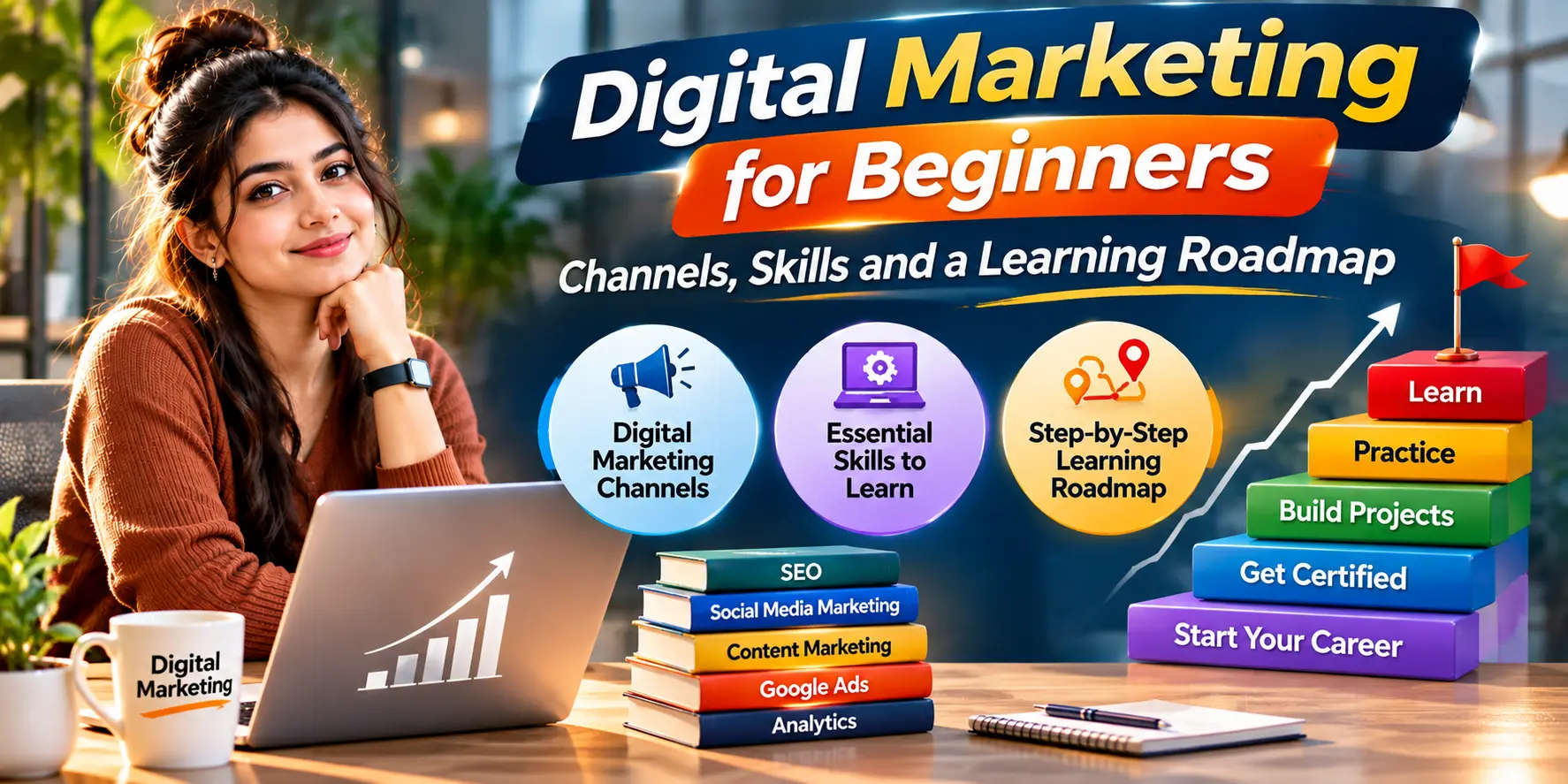
Digital marketing is the practice of promoting a business, product, service or idea through online channels such as search engines, websites, social media, email and online ads, and then using data to see what worked. If you are a student, a career changer, a freelancer or a small business owner, this guide explains how the main channels fit together, which skills to build first, and how to learn in a sensible order.
It does not promise a job, an income or guaranteed business growth. Digital marketing rewards steady practice, honest measurement and patience, and this guide is built around those three things.
What Is Digital Marketing?
Traditional marketing, such as hoardings, newspaper ads and pamphlets, reaches people through offline media. Digital marketing reaches them where they already spend time online: searching on Google, scrolling Instagram or YouTube, checking email, or messaging on WhatsApp.
Two features make it different. First, targeting: you can show a message to people searching for a specific thing or matching a specific interest, location or behaviour. Second, measurement: you can see how many people saw, clicked, enquired or bought, and adjust. Measurement does not make results certain, but it lets you learn from every campaign.
How Digital Marketing Works: From Attention to Action
Most marketing journeys, online or offline, follow a rough sequence. It is a mental model, not a rigid law, because real customers move back and forth.
- Awareness: a person discovers you exists, for example through a search result, a video or a friend’s share.
- Consideration: they compare you with alternatives, read your website, check reviews or follow your page.
- Action: they enquire, sign up, call, visit or buy.
- Retention and advocacy: they come back, and ideally recommend you to others.
Each channel below tends to be stronger at some of these stages than others. Good digital marketing is mostly about choosing the right channel for the stage your audience is in.
Organic vs Paid Digital Marketing
Organic marketing earns attention without paying for each click or view: a useful blog post that ranks in search, a video people share, an email list you built. It is usually slower to build, but the assets (content, audience, reputation) keep working. Paid marketing buys attention directly: you pay a platform to show your ad. It can start sending visitors soon after launch, but visibility generally stops when the spending stops.
Neither is better in all cases. A new local business with a small budget often starts with a Google Business Profile, a simple website and a few useful pages, then adds paid ads once it knows which offers convert.
The Main Digital Marketing Channels
| Channel | What it does | Organic or paid | Common beginner metric |
| SEO | Helps your pages appear in unpaid search results for relevant queries | Organic | Impressions, clicks and queries in Search Console |
| Content marketing | Publishes useful articles, videos or guides that answer audience questions | Organic | Page views, time on page, sign-ups |
| PPC / search ads | Shows ads to people searching for specific terms; you pay per click | Paid | Clicks, cost per click, conversions |
| Social media | Builds community and reach on platforms such as Instagram, YouTube, LinkedIn and Facebook | Both | Reach, engagement rate, followers gained |
| Email marketing | Sends updates and offers to people who opted in | Owned audience | Open rate, click rate, unsubscribes |
| Analytics | Measures what all other channels are doing | Supports all | Sessions, conversions, traffic sources |
SEO (Search Engine Optimisation)
SEO is the work of making your website easy for search engines to find, understand and trust, and useful for the people searching. It covers topics and keywords, page content, site structure, technical health and earned links from other sites. Google’s own SEO Starter Guide is the best official place to begin, and it is clear that no one can guarantee a particular ranking. Expect SEO to be gradual.
Content Marketing
Content marketing means creating material that genuinely helps your audience: how-to guides, comparisons, short videos, templates, checklists. It feeds nearly every other channel. A strong guide can rank in search, be shared on social media and be linked from an email newsletter.
PPC and Paid Search
PPC (pay-per-click) advertising lets you bid to show ads, most commonly on Google Search, when someone types a relevant query. Because you pay for clicks, tracking is essential: you need to know whether those clicks turn into enquiries or sales. Beginners should start with a small, clearly capped budget and a single goal.
Social Media Marketing
Social platforms are where people discover brands, watch demonstrations and talk to each other. Each platform has its own culture and format. Pick one or two that suit your audience instead of trying to be everywhere. Features and algorithms change often, so rely on a platform’s official help pages for current details.
Email Marketing
Email lets you speak directly to people who have agreed to hear from you, which makes it one of the few channels you own rather than rent from a platform. Build your list with permission, send useful messages on a predictable schedule and always offer an easy way to unsubscribe.
Analytics: The Layer That Connects Everything
Analytics tools such as Google Analytics and Google Search Console show where visitors come from and what they do. Without analytics you are guessing. Learn to ask simple questions of the data: Which pages get visits? Which source sends people who actually enquire? Which campaign cost more than it returned?
How the Channels Work Together: A Small-Business Example
Illustrative scenario (not a real case study): A neighbourhood bakery in a mid-sized Indian city wants more orders for custom cakes.
- Foundation: it completes its Google Business Profile with accurate hours, photos and a phone number, and builds a simple website with a cake menu and an enquiry form.
- SEO and content: it publishes a guide on how to choose a cake size for a party. People searching that question may find the site.
- Social media: it posts short videos of cakes being decorated and shares the guide.
- Email or messaging: it invites customers to opt in for festival offers.
- Paid ads (later): once enquiries are tracked, it tests a small search-ad budget for “custom birthday cake” searches in its area.
- Analytics: every month it checks which source produced the most enquiries and moves effort accordingly.
The point is the system, not any single tactic: each channel supports the others, and measurement decides what to do next.
Essential Digital Marketing Skills for Beginners
| Skill | Why it matters and how to practise |
| Clear writing | Almost every channel depends on words. Practise writing headlines, short product descriptions and helpful explanations. |
| Audience research | Learn to describe who you are speaking to and what problem they want solved. Read forums, reviews and search results to hear their language. |
| Basic SEO and keyword research | Understand search intent (what the searcher actually wants) and how to match a page to it. |
| Analytics literacy | Read a traffic report, spot a trend, and separate vanity metrics (likes, followers) from outcomes (enquiries, sales). |
| Social media basics | Know the formats, posting habits and community norms of one platform well. |
| Paid ads fundamentals | Understand budgets, bidding, targeting and conversion tracking before spending real money. |
| Email basics | Learn list-building with consent, simple segmentation and subject-line testing. |
| Simple design and editing | Be able to make a clean graphic or short video using beginner-friendly tools. |
| Spreadsheets and reporting | Keep tidy numbers and summarise what happened and what you will do next. |
| Testing mindset | Change one thing at a time, record it and learn from the result, including failures. |
A Realistic Learning Roadmap
There is no single correct order, and speed depends on how much time you can give. This sequence moves from understanding to doing, so every stage ends with something you can show.
| Stage | Focus | What to do | Output |
| 1. Foundations | How channels, funnels and search intent work | Complete a free beginner course; read official guides such as Google’s SEO Starter Guide | A one-page summary in your own words |
| 2. Own platform | Build something you control | Create a simple blog or website on a topic you care about; set up Search Console and Analytics | A live site with tracking |
| 3. Channel practice | Try one organic channel and one other | Publish regularly; write a few SEO-minded articles; run a small social or email experiment | A content log with results |
| 4. Paid basics | Understand ads safely | Use training accounts or a very small capped budget; study how conversion tracking works | A short write-up of what you learned |
| 5. Specialise | Go deeper in one area | Choose SEO, performance ads, social media, content or analytics based on what you enjoy | A focused portfolio piece |
A free starting point is Google’s Fundamentals of Digital Marketing course, offered through Grow with Google and Skillshop. Course contents and certificate availability change, so check the official page for current details. Meta Blueprint and HubSpot Academy also publish free training. A certificate shows you completed a course; employers and clients usually care more about what you have actually made and measured.
Starter Projects and Portfolio Ideas
A portfolio is evidence of what you can do. Be honest about what each project is and what it achieved.
- Build and document a personal or topic blog. Show your keyword research, article planning and Search Console data over time.
- Optimise a real local listing for a friend’s or family member’s business, with permission. Record the before-and-after changes you made and the results you can actually verify.
- Run a small content experiment on one social platform. Post for a set period, track what performs and explain what you learned.
- Create a lead magnet and email sequence. A short checklist plus a three-email welcome series, tested with a few real subscribers.
- Write a mini audit. Review one small website for basic SEO and usability issues and propose prioritised fixes. Only publish it with the owner’s consent.
- Make a measurement dashboard. Use free tools to turn real traffic numbers into a simple monthly report.
Portfolio rule: never present practice work as client work, and never publish numbers you cannot verify. Small, true projects are more credible than impressive but invented ones.
Beginner-Friendly Tools to Know
You do not need a large toolkit. These free options cover the basics. Features and pricing change, so confirm details on each official site.
- Google Search Console: shows how your site performs in Google Search and flags indexing issues.
- Google Analytics: reports on website and app visitors and what they do.
- Google Business Profile: manages how a local business appears on Google Search and Maps.
- Google Trends: shows how interest in a topic changes over time.
- A design tool such as Canva: for simple graphics. Check its current free-plan limits.
A fuller comparison of keyword, SEO, analytics, social and email tools belongs in a dedicated guide so this article stays focused on getting started.
Common Beginner Mistakes
- Trying every channel at once. Depth in one or two channels beats thin effort across six.
- Chasing tricks and “hacks”. Durable results come from useful content, a sound website and clear offers.
- Ignoring search intent. A page that does not answer what the searcher wanted rarely performs, however well it is optimised.
- Judging success by vanity metrics. Followers and likes are signals, not outcomes.
- Spending on ads before tracking works. Without conversion tracking you cannot tell whether the money did anything.
- Expecting fast results from SEO. It usually takes sustained effort, and no tool or person can guarantee rankings.
- Copying competitors. Learn from what they cover, then add your own experience, examples and clearer explanations.
How to Measure Digital Marketing Results
Start with a goal, then choose metrics that show progress toward it. Check what your own tools define each metric as, because platforms differ.
| Goal | Useful metrics | Where to look |
| Be found in search | Impressions, clicks, average position, top queries | Google Search Console |
| Bring visitors to your site | Sessions or users, traffic source, top pages | Google Analytics |
| Generate enquiries or sales | Conversions, conversion rate, cost per lead or sale | Analytics, ad platform, CRM or a simple spreadsheet |
| Grow an audience | Reach, engagement rate, follower growth, saves and shares | Each social platform’s insights |
| Nurture subscribers | List growth, open rate, click rate, unsubscribes | Your email tool |
| Judge paid campaigns | Cost per click, conversion rate, cost per conversion | The ad platform with conversion tracking |
Review numbers on a regular schedule, such as monthly, and write one sentence about what you will change. A metric with no action attached is just decoration.
Key Takeaways
- Digital marketing combines several channels, and measurement connects them.
- Organic builds lasting assets more slowly; paid can start quicker but depends on continued spending.
- Learn the basics first, build something of your own, then specialise.
- Be honest in your portfolio and cautious about promises of results.
Frequently Asked Questions
Is digital marketing a good career for beginners?
It can be a good entry point because there is a lot of free training and you can practise on your own projects. Opportunities and pay vary by role, city and employer, and no one can promise a job. Build visible skills and keep learning as platforms change.
How long does it take to learn digital marketing?
You can understand the fundamentals in a few weeks of regular study, but competence in a channel comes from months of practice. Treat it as continuous learning because tools and platform rules keep changing.
Do I need to know coding?
Not for most beginner roles. Basic familiarity with how websites work, plus comfort with spreadsheets and analytics, is far more useful at the start. Coding becomes relevant mainly in technical SEO or marketing automation.
Which channel should a small business start with?
Start where your customers already look. Local businesses often begin with an accurate Google Business Profile and a simple website. Businesses with a clear online offer may test search ads. Pick one or two channels, track them and expand from there.
Can I learn digital marketing for free?
You can learn a great deal for free through official guides, platform training and your own practice projects. Paid courses can add structure or mentoring, but they are not required. Compare what each course teaches and check recent reviews before paying.
What is the difference between SEO and PPC?
SEO aims to earn visibility in unpaid search results and builds gradually. PPC pays for ads shown to searchers and can begin quickly, but stops when you stop paying. Many businesses use both and measure each separately.