



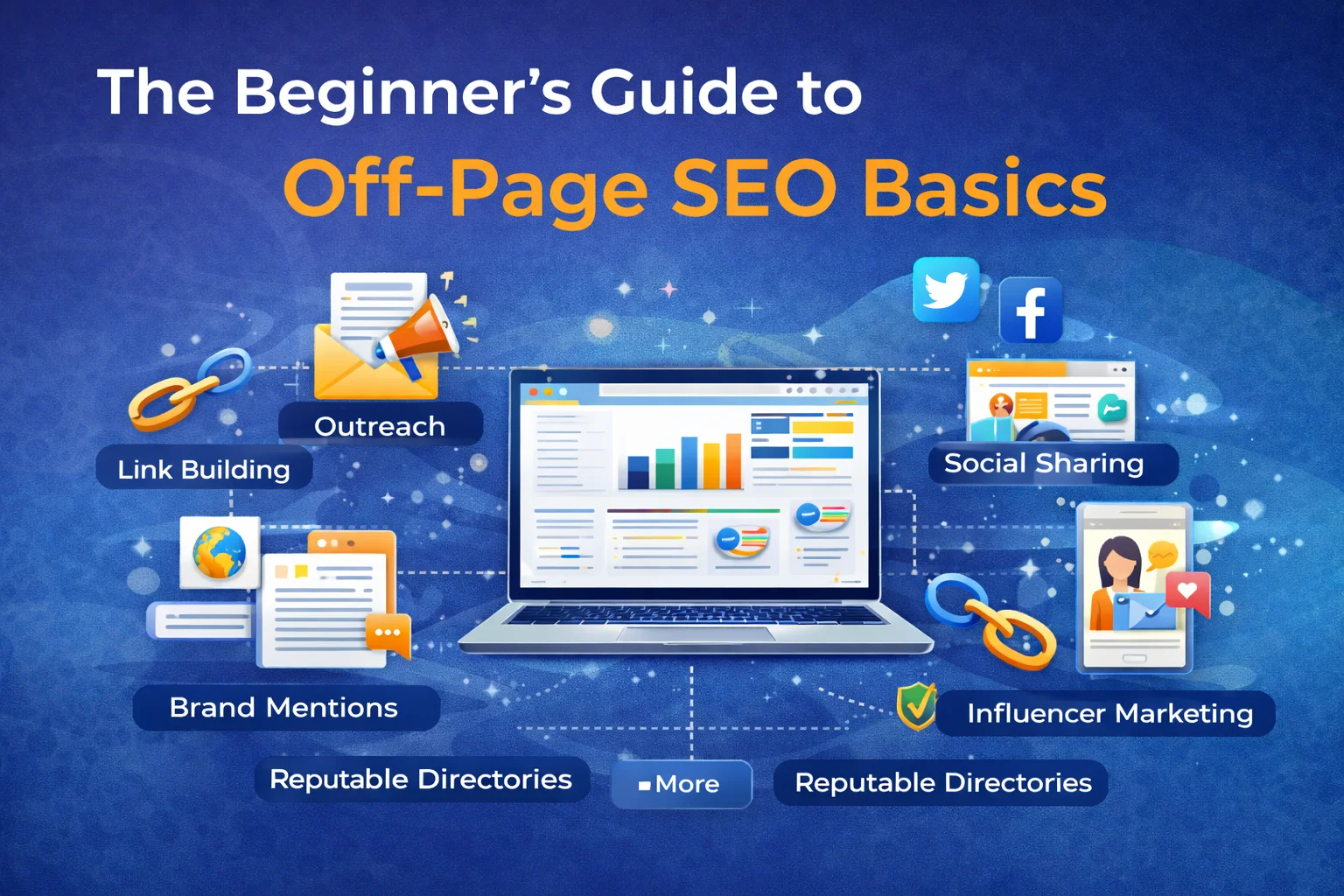
If you’re new to online growth and still wondering what is digital marketing, think of it as everything you do on the internet to bring customers to your business,Google search, social media, ads, emails, and more. In that bigger picture, Off-Page SEO is one of the most practical ways to build trust for your website outside your website.
This guide is written for Indian students, startup founders, freelancers, local shop owners, and professionals upskilling. You’ll learn the basics in very simple language, with real Indian small-business examples in every section,so you can actually apply it.
- What Off-Page SEO
Off-Page SEO is everything that helps your website rank higher because other people and platforms “vouch” for you. Google looks at signals like links, brand mentions, reviews, and business listings to understand if your business is trusted.
Practical insight:
If your website is “good,” but nobody talks about it, Google has fewer reasons to show it above competitors. Off-page signals are like outside proof.
Example:
A home bakery in Indore may have a basic website. But if local food bloggers link to it, Google Maps reviews are strong, and it’s listed correctly on Justdial and Instagram, it often ranks higher for “custom cakes in Indore.”
- Off-Page SEO vs On-Page SEO
- On-page SEO:Changes on your website (titles, content, speed, internal links).
- Off-page SEO:Trust signals outside your website (links, citations, reviews, PR).
Both work together. Search engine optimization works best when your website is strong and your brand looks reliable outside the site.
Practical insight:
Don’t spend months chasing backlinks if your pages are confusing or your phone number is missing.
Example:
A Jaipur salon created backlinks by listing on directories, but their site had no service pages (hair spa, bridal makeup). After adding those pages (on-page), the off-page work started showing results.
- Why Off-Page SEO
many categories are crowded: coaching classes, tiffin services, boutiques, tuition teachers, CA firms, home services, and D2C brands. Off-page signals help Google decide who is real and popular.
Practical insight:
Local competition is not only websites, Google Business Profile listings also compete. Off-page factors (reviews, mentions, citations) directly influence visibility.
Example:
A laptop repair shop in Pune got more calls after customers started mentioning “quick service” in reviews and a local tech forum linked to their pricing page.
- The Trust Formula: Links + Mentions + Reviews + Consistency
Google’s goal is to show safe, trusted, useful results. Off-page SEO builds that “trust layer” through:
- Quality backlinks (relevant websites linking to you)
- Brand mentions (even without links)
- Reviews and ratings
- Consistent business details across the web
This is the heart of SEO Off-Page work: building reputation without shortcuts.
Practical insight:
Trust is built when multiple sources repeat the same story: your name, location, services, and customer satisfaction.
Example:
A student visa consultant in Chandigarh improved ranking after consistent listings (same address and phone) on Google, Sulekha, and a local education portal,plus detailed reviews.
- Business Listings That Actually Help
A Business Listings is any online place where your business name, address, and phone (NAP) appears,Google, Justdial, IndiaMART, Sulekha, Facebook, MapmyIndia, local directories, etc.
Practical insight (simple checklist):
- Keep NAP exactly the same everywhere (format matters)
- Add categories correctly (don’t choose random ones)
- Add working hours, website, and photos
- Remove duplicate listings
Example :
A physiotherapy clinic in Navi Mumbai had two different phone numbers on Practo and Google. After fixing it, missed calls reduced and Google Maps visibility improved in 3–6 weeks.
- Google Business Profile Reviews: The Easiest Off-Page Win
Reviews are “public proof.” They help rankings, clicks, and conversions. Ask ethically,never buy fake reviews.
Practical insight (review system that works):
- Ask right after service (when the customer is happiest)
- Send a short WhatsApp message with the review link
- Reply to every review (positive and negative) politely
- Encourage customers to mention the service + area (naturally)
Example (India):
A mobile accessories retail shop in Surat started asking every happy customer for a review at the billing counter. In two months, they went from 12 reviews to 90+ and started showing up more often for “mobile shop near me.”
- Backlinks 101: Quality Beats Quantity (Always)
A backlink is when another website links to yours. But not all links are equal. One link from a respected, relevant site can beat 100 random links.
Practical insight:
A good backlink usually has:
- Relevance (same industry or local area)
- Real traffic (people actually visit that site)
- Natural placement (inside helpful content, not spammy footers)
This is where Search engine optimization becomes “real business building,” not tricks.
Example :
A Bengaluru-based UI/UX freelancer got a backlink from a startup community blog after writing a guest article on “app onboarding mistakes.” That one link brought direct leads and improved search visibility.
- Safe Link-Building Ideas for Indian Small Businesses
Here are beginner-safe ways to earn links (not buy them):
- Supplier/partner links (vendor pages)
- Local chamber of commerce/association listings
- College alumni pages (for student founders)
- Guest posts on niche blogs (only relevant)
- Testimonials (you give a testimonial to a tool/vendor and they link to you)
Practical insight:
Create a simple “About + Services + Contact” page worth linking to. If the page looks empty, people hesitate to reference it.
Example :
A small packaging manufacturer in Noida got links from 3 clients by providing a short testimonial; clients added it on their “Partners” page with a link back.
- Local PR and Community Mentions
You don’t need national news. Local PR works well: city blogs, local newspapers, society newsletters, event pages, and NGOs.
Practical insight:
Do one community activity per quarter and document it:
- Sponsor a school event
- Conduct a free workshop
- Support a local clean-up drive
Then pitch the story to local pages that publish community updates.
Example :
A coaching institute in Lucknow hosted a free career guidance session in a nearby college. The college website published an event recap and linked to the institute—strong local relevance.
- Content That Naturally Attracts Links
If you publish something genuinely useful, people link to it. Great “linkable” content for Indian businesses includes:
- Price guides (transparent cost breakdown)
- Checklists (downloadable PDF)
- Local resource lists (best vendors, forms, processes)
- Case studies (before/after with numbers)
Practical insight:
Make the content extremely specific to your city/area. Generic content gets ignored.
Example :
A GST consultant in Ahmedabad posted “GST registration documents checklist (with sample format).” A local startup incubator shared it and linked to the page.
- Social Media Helps Off-Page SEO (In an Indirect Way)
Social media links may not pass strong SEO value the same way editorial links do, but social visibility can create:
- Brand searches (“Brand name + service”)
- Shares that lead to real backlinks
- More reviews and mentions
This is a clean, sustainable part of SEO Off-Page growth,build a brand people look for.
Practical insight:
Focus on “search-friendly social”:
- Use the same brand name everywhere
- Add location in bio
- Pin service posts and WhatsApp link
- Keep phone/address consistent
Example :
A Chennai-based saree boutique posted customer draping videos on Instagram Reels. Local fashion bloggers later mentioned the boutique on their websites, creating natural backlinks.
- Influencers and Micro-Creators: Use Them Smartly
You don’t need celebrity influencers. Micro-creators (5k–50k followers) often bring better local trust at lower cost.
Practical insight:
Instead of paying for a “shoutout,” propose a useful collaboration:
- Invite them for an honest trial
- Ask for a blog/YouTube description link
- Offer a unique coupon code to track sales
Example :
A cloud kitchen in Hyderabad partnered with two local food reviewers. One wrote a Google Maps review + added the order link in their blog. Orders increased and the brand started appearing more for “best biryani near me.”
- What to Avoid: Fake Links, Paid Link Packages, and Spam
Many Indian businesses get calls like: “500 backlinks in 7 days.” That usually leads to spammy links that can hurt rankings over time.
Practical insight:
Avoid:
- Link farms and bulk directory submissions
- Paid guest posts on irrelevant sites
- Comment spam on blogs
- Fake reviews
If you already did it, don’t panic,focus on building quality signals and cleaning up gradually.
Example :
A Delhi NCR startup bought a cheap backlink package and saw a short spike, then a drop. After stopping spam and building real partnerships (incubator links, founder interviews), traffic stabilized.
- A Simple 30-Day Off-Page SEO Plan (Beginner Friendly)
Here’s a realistic plan you can follow without a big budget.
Week 1: Set your foundation
- Fix NAP consistency everywhere
- Update Google Business Profile (photos, services, description)
- Create a review request message template
Example :
A Kanpur tuition teacher updated their Google profile with subjects, timing, and location map pin,calls improved within days.
Week 2: Build citations + credibility
- List business on 10–15 relevant platforms (quality > quantity)
- Add 5 new photos on Google Business Profile
- Reply to all existing reviews
Example :
A Nagpur electrician added accurate service categories and photos; profile visits increased and “direction requests” went up.
Week 3: Earn 2–3 real backlinks
- Ask 3 partners/vendors for a link
- Publish one helpful guide on your site
- Pitch one guest post to a relevant blog
Example :
A Kerala handmade soap brand got a link from an eco-store’s “Our Suppliers” page.
Week 4: Track and improve
- Track calls, WhatsApp clicks, form fills
- Monitor Google Search Console for queries
- Double down on what’s working
Example :
A Mumbai freelancer noticed most traffic came from “logo designer for restaurants,” so they wrote a dedicated page and earned a backlink from a restaurant association group.
- How to Measure Off-Page SEO Results (Without Overthinking)
You don’t need advanced tools to start. Track these:
- Google Business Profile insights (calls, direction requests)
- Search Console clicks + queries
- Website traffic from referrals (other websites)
- Ranking movement for local keywords
- Leads (calls, WhatsApp, forms)
Practical insight:
Real success is not only rankings. If referrals bring leads, your off-page work is paying.
Example :
A Coimbatore interior designer saw only a small ranking change, but received 8 leads from a local real estate blog that linked to their portfolio page,high-quality business impact.
5) Internal Linking Suggestions (Add These Inside Your Website)
If you run a blog or service site, link this article to:
- On-Page SEO checklist(titles, headings, service pages)
- Local SEO guide for India(Google Business Profile setup + maps ranking)
- Content marketing basics(how to write helpful pages that attract links)
- Google Business Profile optimization service page
- Digital marketing for small businesses in India(overview article)
- Case study page(before/after results for a local client)
6) Call-to-Action (For Small Businesses)
If you’re a small business owner, don’t wait for “perfect.” Start with the basics this week:
- Fix your business listings (NAP consistency)
- Ask 10 genuine customers for reviews
- Reach out to 5 partners for a mention or link
- Publish 1 helpful local guide on your website
If you want faster, cleaner results, consider getting a simple off-page audit and a monthly plan focused on reviews, listings, and real local backlinks,no spam, no shortcuts, only sustainable growth through Search engine optimization and trust-building.
7) 15 Most Searched FAQs Related to Digital Marketing
- What is digital marketing?
Digital marketing is promoting your products/services using online channels like Google, social media, email, and websites. - What is SEO in digital marketing?
SEO is improving your website and online presence so you rank higher on Google and get organic traffic. - What is Off-Page SEO in simple terms?
It’s building trust for your website through backlinks, reviews, mentions, and listings outside your site. - How long does Off-Page SEO take to work?
Usually 4–12 weeks for early signals; stronger results often take 3–6 months depending on competition. - Are backlinks still important in 2026?
Yes—quality backlinks and brand mentions remain strong trust signals when earned naturally. - How many backlinks do I need to rank?
There’s no fixed number. A few relevant links can beat many low-quality links. - What is local SEO and why is it important in India?
Local SEO helps you appear in “near me” and city-based searches, especially on Google Maps,crucial for local businesses. - How can I get more Google reviews legally?
Ask real customers after service, share a direct review link, and respond to all reviews politely. - Does social media improve SEO rankings?
Indirectly, yes. Social media increases visibility, brand searches, and can lead to real backlinks. - What is the difference between SEO and paid ads?
SEO builds organic traffic over time; paid ads bring immediate visibility but stop when you stop paying. - Which is better for beginners: SEO or social media marketing?
Do both lightly: social for quick visibility and trust, SEO for long-term leads and lower cost per lead over time. - What is content marketing in digital marketing?
Creating helpful content (blogs, videos, guides) to attract customers and build trust instead of hard selling. - Can small businesses do SEO without an agency?
Start with Google Business Profile, basic site pages, reviews, and a few local backlinks. - What is a citation in SEO?
A citation is your business listing online with your name, address, and phone number (NAP). - What mistakes should I avoid in Off-Page SEO?
Avoid buying backlinks, fake reviews, irrelevant directory spam, and inconsistent business details online.